House of Chusa
추사고택
History · 261, Chusagotaek-ro, Yesan-gun, Chungcheongnam-do
Nearby stations and stops
- Bus stop 추사고택 · straight-line 13m
- Bus stop 추사고택앞 · straight-line 25m
Straight-line distance; the actual walk is longer · Data as of 2025-10-31
Source: Ministry of Land, Infrastructure and Transport nationwide bus stop locations
- Admission
- Not provided
- Hours
- March-October 09:00-18:00
- November-February 09:00-17:00
- * Last admission is 30 minutes before closing.
- Closed
- Open every day
- N/A (open all year round)
- Parking
- Parking available
- Available
- Pets
- Not provided
- Accessibility
- Not provided
- Data status
- Source: Korea Tourism Organization TourAPI · Source updated: 2022-12-28 · Collected: Not provided
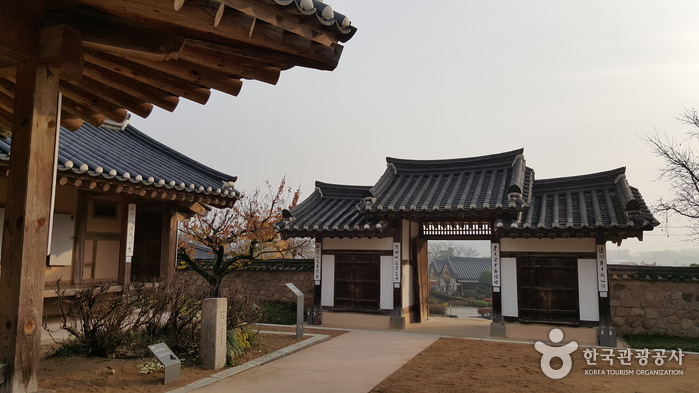
House of Chusa, Chusa Gotaek in Korean, is the traditional Korean house of the renowned scholar and calligrapher Chusa, also known as Kim Jeong-hui. This old house is known to have been constructed by the great-grandfather of Chusa, Kim Han-Sin. The Korean-style house compound (266.11 m²) consists of munganchae (a guesthouse), soseuldaemun (a high gate), sarangchae (ㄱ-shaped men's quarters), anchae (ㅁ-shaped women’s quarters) and a shrine where the remains of Chusa are enshrined. Theㄱ-shaped Sarangchae stretches for one kan (traditional measuring unit) to the south and 2 kans to the east and is comprised of two rooms and a daecheongmaru (living area). The Anchae consists of a six-kan daecheongmaru and two one-kan rooms. Located on the ground is a tomb where Chusa’s great-grandfather (Kim Han-Sin) and his wife (Hwasun Princess) are buried. Nearby, visitors will see a gate that was constructed to commemorate Princess Hwasun’s faithfulness to her husband. Located approximately 600 meters to the north of the old house is a lacebark pine tree, which was designated as a Natural Monument. The lacebark pine tree, originally from northern China, is among the few of its kind in Korea. It is said that Chusa snuck the pine across the border from China (formerly, the Qing dynasty) into the country when he was 25 years old and planted it at the tomb of his great-grandfather. Originally, the tree had three branches, but two were broken and the third branch was damaged. In 1980, the damaged branch was treated and since then, the tree has been kept under strong protection.
In the area
Traditional Houses 2 of 7 attractions in Yesan-gun
Similar places nearby
Similar places in other regions
- Goesan Historic House of Song Byeong-il · Chungcheongbuk-do
- Saudang Head House · Gyeongsangbuk-do
- Imcheonggak House · Gyeongsangbuk-do
- Choi Champandaek (House of Choi Champan) · Gyeongsangnam-do
- Songso House · Gyeongsangbuk-do
Source: Korea Tourism Organization TourAPI