Gyeongbokgung Palace
경복궁
History · 161 Sajik-ro, Jongno-gu, Seoul
Nearby stations and stops
- Gyeongbokgung (Government Complex-Seoul) (Line 3) · straight-line 278m
- Gwanghwamun(Sejong Center for the Performing Arts) (Line 5) · straight-line 488m
- Bus stop 경복궁 · straight-line 183m
- Bus stop 경복궁역(효자로입구) · straight-line 226m
Straight-line distance; the actual walk is longer · Data as of 2025-10-31
Source: Korea National Railway urban rail station information · Ministry of Land, Infrastructure and Transport nationwide bus stop locations
- Admission
- Not provided
- Hours
- November-February 09:00-17:00 (Last admission 16:00) March-May & September-October 09:00-18:00 (Last admission 17:00) June-August 09:00-18:30 (Last admission 17:30)
- Closed
- Tuesdays (If Tuesday falls on a public holiday, it will be closed on the following business day instead)
- Parking
- Parking available
- Available
- Pets
- Not provided
- Accessibility
- Not provided
- Data status
- Source: Korea Tourism Organization TourAPI · Source updated: 2026-04-16 · Collected: Not provided
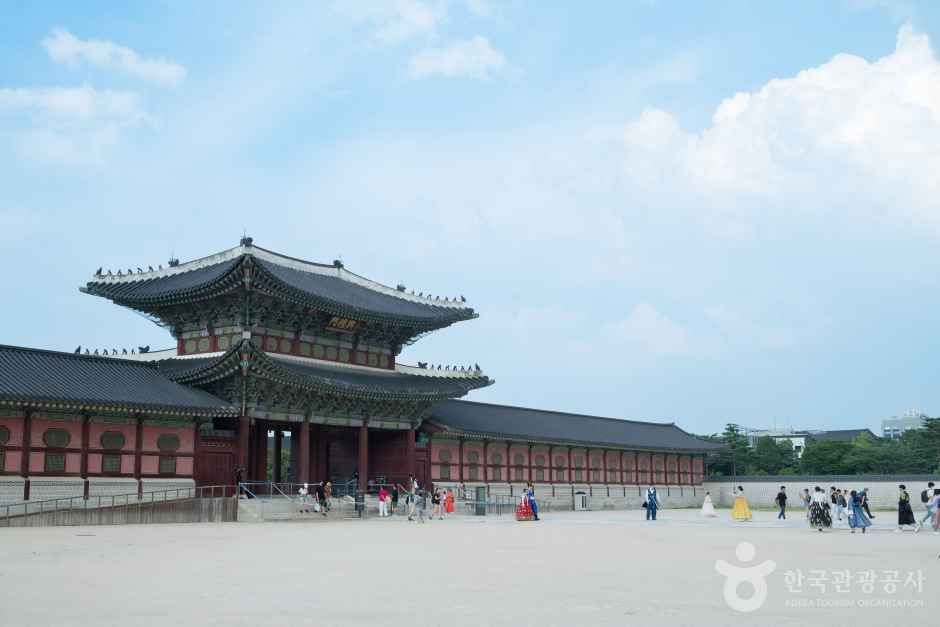
Gyeongbokgung Palace was built in 1395 as the official palace of the Joseon dynasty by Yi Seong-gye, the future King Taejo and founder of the new regime. Gyeongbokgung Palace is commonly referred to as the Northern Palace because of its location to the north, comparied to Changdeokgung Palace in the east and Gyeonghuigung Palace in the west. Gyeongbokgung Palace is arguably the most beautiful and is the largest of all five palaces. Many Joseon kings were crowned here. The premises were once destroyed by fire during the Imjin War (1592-1598). However, all of the palace buildings were later restored under the leadership of Heungseondaewongun during the reign of King Gojong. The assassination of Empress Myeongseong, however, resulted in Gyeongbokgung Palace losing its function as a royal palace, eventually witnessing the downfall of the Joseon dynasty. Gyeongbokgung Palace retains the original Gyeonghoeru Pavilion, a prime example of Joseon architecture, and the Hyangwonjeong Pavilion and pond. The sculptures in the Geunjeongjeon Hall exemplify Joseon-era sculpture techniques. The west side of the area outside Heungnyemun Gate is occupied by the National Palace Museum of Korea, while the eastern side of Hyangwonjeong Pavilion within the Gyeongbokgung Palace is occupied by the National Folk Museum of Korea.
In the area
Royal Palaces 6 of 71 attractions in Jongno-gu
Similar places nearby
- Unhyeongung Royal Residence · 918m
- Gyeonghuigung Palace · 954m
- Changdeokgung Palace Complex [UNESCO World Heritage Site] · 1.2km
- Nakseonjae Hall · 1.5km
- Changgyeonggung Palace · 1.8km
Similar places in other regions
- Gyeongju Wolseong Palace Site (Banwolseong Fortress) (경주 월성(반월성)) · Gyeongsangbuk-do
- Gyeonggijeon Shrine · Jeonbuk-do
- Yongheunggung Palace · Incheon
- Temporary Palace at Hwaseong Fortress (Hwaseong Haenggung Palace) · Gyeonggi-do
- Birthplace of Empress Myeongseong (Queen Min) · Gyeonggi-do
Source: Korea Tourism Organization TourAPI